'I think therefore I am.'  Descartes            'I AM THAT I AM.'  Exodus.3.        'I am what I am.'  La Cage aux Folles

Showing posts with label Philosophy. Show all posts

29 August 2013

Meditation

Meditate on nature's endless cycle of creation and destruction.
Render and Thistle (2009) from Karl Cronin
Meditation is described as silencing the mind, removing extraneous thoughts and distractions so that concentration is increased and peace from the turmoil of a too busy world is achieved.
Here are thoughts and images of meditation and contemplation to soothe your soul perhaps relax you and direct you to paths of peace. Think and then stop.
Photography is an immediate reaction, drawing is a meditation. 
Henri Cartier-Bresson 
Meditation is the dissolution of thoughts in Eternal awareness or Pure consciousness without objectification, knowing without thinking, merging finitude in infinity. 
Voltaire 
The more man meditates upon good thoughts, the better will be his world and the world at large. 
Confucius
Divinely bent to meditation;
And in no worldly suits would he be mov’d,
To draw him from his holy exercise.
William Shakespeare, Richard III Act 3, Scene 7
If you mind is empty, it is always ready for anything; it is open to everything.  In the beginner’s mind there are many possibilities, in the expert’s mind there are few.
Shunryu Suzuki
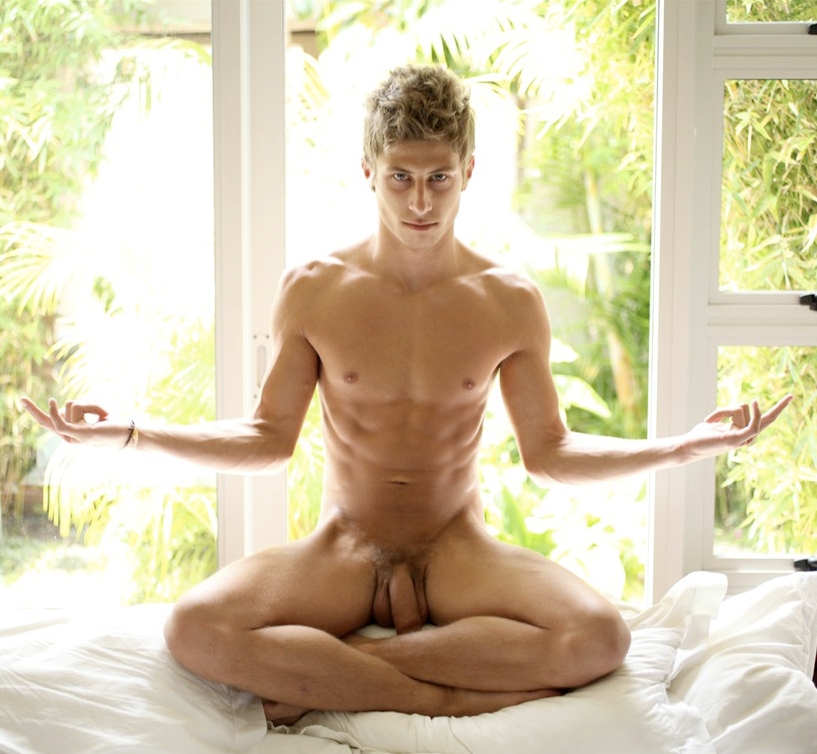
Is this a half lotus position?
Everything is based on mind, is led by mind, is fashioned by mind. If you speak and act with a polluted mind, suffering will follow you, as the wheels of the oxcart follow the footsteps of the ox. Everything is based on mind, is led by mind, is fashioned by mind. If you speak and act with a pure mind, happiness will follow you, as a shadow clings to a form.
Buddha
I just like the idea of always thinking of nice things and hence extract the essence of niceness. Put beauty in your mind, contemplate it's glory and let it wash all over you. You will be trance like and you will find peace. You will be happy if all is beauty. Sleep and bathe in what is simply and deeply beautiful.
--------------------------------------------------------------------
Many years ago I knew a beautiful person who had waist length hair and possessed a radiant face. Some years later he arrived on my doorstep as a Hare Krishna and still as androgynous as Krishna himself. He stayed a few days and was still mesmerisingly radiant as he meditated naked in my home. 
Now relax and take time for the beauty of 
The Great Bell Chant
The Great Bell Chant (The End of Suffering) from R Smittenaar on Vimeo.

09 January 2013

Homophobia or Equality

Reassembled old posts and some new bits just to keep the quest going.
Some photos that make a point.
Fight Religious intolerance 
 Fight Political persecution
 Make a statement
Be Fabulous
--------------------------------------------------------------------------------------------------------
An Email I received today in March 2012

THE SENATE
STANDING COMMITTEE ON LEGAL AND CONSTITUTIONAL AFFAIRS
29 March 2012
E-mail: historyandphilosophy@gmail.com
 Marriage Equality Amendment Bill 2010
I am writing to acknowledge receipt of your email to the above inquiry and to advise that the committee has accepted the email as Form Letter 1, or a variation of Form Letter 1 (that is, a form letter in which a personal story or general commentary is attached/included). If you have requested that your email be treated confidentially by the committee, that request has been accommodated.
You are advised that all documents provided to Senate committees become committee documents upon receipt, and it is the prerogative of the relevant committee to determine whether and how it will accept and publish such documents. In this inquiry, the committee will publish on its website one example only of each type of form letter, as time and resources permit (that is, one example of Form Letter 1; one example of Form Letter 2, and so on). The names of those who have submitted form letters will not be published on the website. The committee is anticipating the receipt of thousands of form letters throughout the course of this inquiry, and it is not physically possible for them to be published on the website due to staffing and resource limitations. However, all form letters will be available to members of the committee during the course of the inquiry for their consideration, and the numbers of form letters received will be published on the website periodically.
Your email is protected by parliamentary privilege. Parliamentary privilege refers to the special rights and immunities attached to the Parliament which are necessary for the discharge of parliamentary functions. This means that you cannot be prosecuted or disadvantaged because of anything you have provided in evidence, or because you gave such evidence. If you have requested confidentiality, you are protected by parliamentary privilege in respect of your email, but this protection will be lost if you make it public without the committee's prior agreement.

Yours sincerely
Committee Secretary
-----------------------------------------------------------------------------
March 21, 2012. It's not every day that a major world figure speaks out forcefully in defense of equality. But earlier this month, U.N. Secretary General Ban Ki-moon did just that when he made an incredibly powerful speech at the U.N. in Geneva. 
But most people didn't even hear about it. 
Why? After the speech, the media focused on a handful of delegates who stormed out of meeting in protest. Their story - that gay people should be denied human rights - is the one that dominated the day's news. But with your help, we're going to change that. 
Our friends at the U.N. let us REMIX Ban Ki-moon
, so we took his speech and created this video. We hope you like it! After you watch, please share with your friends and family, helping this inspiring message reach the audience it deserves.


Australian favourite actress Magda Szubanski (from the film Babe for international readers) 
Magda Comes Out and Supports Gay Marriage.
On the light side. Some positive ideas.

Click this link to watch '8' The Marriage Equality Play in full
People are demanding rights all over the world
and here
Great Australian Marriage Equality Adds.

Some of you might not like Stephen's comments, but I applaud them with enthusiasm. I was once a devout Catholic contemplating the priesthood and have been to several Papal audiences in Rome and have even received a letter from a previous Pope. I now believe the Pope particularly the current one and his church as he rules it, to be one of the most divisive, nasty and evil people and institutions on the planet. He and his church supports ignorance and persecution, encourages hatred and his pronouncements encourage death, gay suicide, homophobia, pain and cruel mental anguish to so many.
Watch!!!!      It is brilliant.
This powerful music film needs few words except to note that Homophobia is not restricted to Russia alone.
Look within your own borders as well. I see it here.
Quote from the Youtube site
Anthemic "I've Only Just Begun" -song will be released digitally (iTunes, Spotify etc.) 3rd of September 2012 in Europe, US, Latin America & Canada.
"I've Only Just Begun" is a ragingly beautiful and empowering story about Venuz Vulgar and his friends on their way to St. Petersburg, Russia.
It's written and directed by E. Over 60 people were involved in this free, independent production. Thank you all. Big up. No fear.
Prejudice - Fabulous Tim Minchin covers it all

11 July 2012

Sage Advice

Created in 1939 by the British Government and rediscovered in 2000.
 To be used in times of crisis to boost morale. How apt.


A Local Australian Parody and desperate plea https://www.facebook.com/KeepCalmAbbottisnotPM
But then again as a friend posted a short time later.

02 August 2011

Remember Hiroshima


 6th. August 1945

 
140,000 died
I do not have to show the horrific images of destroyed fathers, mothers, brothers, sisters, the old and the young. I have a firm belief echoed elsewhere - 
I will not kill.
To me that means anyone, ever, and under any circumstances.
Remember.

14 July 2011

Exposing the human form.

Recently I coined a term that I thought expressed a need to free ourselves and our society from the influence of those who wish to restrict our behaviour, our nature, our beauty, our expression.
Militant Nudity!
Will save the world
(click to enlarge)

Here in Australia we are suffering from excessive interference from the Nanny State. Governments instead of creating an ever increasing free and flourishing society are endeavouring to dictate behaviour in areas that should be left to the individual. The consequence is that they will crush originality, choice and our ability to fail, make mistakes, learn, grow and evolve. Personal development is just that; Personal. As an expression of that I encourage, support and admire those who place themselves in the firing line of so called standard setters. Expose yourself to honest appraisal. Challenge the accepted norms, Be naked.
Terms like Norms, Normal, Average, Common, Accepted, Standards, Majority mean nothing, except a dry statistical approach to life. They mean nothing to progress, creativity, originality and expression of the self. They are the often sought observation of this world as a stew of over-boiled images that blend and make bland. They remove all spice from life. They suck dry the juices of inspiration. The grey day of the common man.
There are artists who are often described as 'out there', 'notorious', 'over the top', 'confronting', 'in your face', 'infamous' etc. who are said to 'push the envelope', 'challenge standards' and 'defy the norm'. Thank the heavens that such beings exist.
Smart, witty and wonderfully executed. (33.35 minutes)

From my novel 'Dance with the Sun'
Sunny had by now become accustomed to meeting up with some friends at Piccadilly Circus after his dancing lessons. Together they sat and discussed existence beneath the centrepiece of Christian Charity. The naked youth raised high on his pedestal amongst the rubbish and poverty of one of the great centres of western civilisation is a glorification of Charity and often mistakenly referred to as the pagan love god Eros. To him the sentiment was the same, and the boy took it as an omen for establishing his new life. The bronze boy was his own personal talisman, his secret friend and brother. Some of this motley city tribe were slightly older, from the University and others, unfortunately he thought, were just stoned. The 'just stoned' ones had little else to recommend them, as that was their reason for existence, which kept them too occupied to participate in many other activities. Disillusioned, without confidence in the future, they sometimes sought escape in personal relief that further relieved them of the need to achieve anything. To him this was a sadness that he could not accept. He liked them but what could he absorb from those whose actions offered little. Selfishly he realised that if he could change them they would have more to give, to return to his life, but he now belonged to that group and he had to survive. The only way he knew was to open himself up to the world. He had no secrets. He had no need of them. He wanted to be accepted, but it had to be in truth. How could people form a judgement of him if he did not expose everything within himself? He was no longer the innocent introvert shying away from strangers. That time, drawn out of necessity had passed. Now he was developing a mission, his light must come out from under the bushel. Without seeing all that was there to know of him, they would be accepting a half image, a lie. Gradually and with rising confidence he began to speak of his longings, his fantasies, his hopes and his dreams. If he set this example, perhaps they would in turn open up to him and from there the inspiration would gather. His stories fascinated them and his participation in life excited them. In those grey days in the dirty city he began to shine. He stood apart.

At night, in his shambled, clothes cluttered bed; Sunny would lay on his back with his feet stretched above him, resting on the cold smeared plaster wall, and think over with impatience the direction his life was taking. So much was being fed into his mind that the need to explore what he could do with it, festered like a swollen boil requiring urgent lancing. New friends were gathering all around him, but the newfound, and now constant fear of stagnation pushed his dreams into a smorgasbord of wildly wonderful images of creativity. He hungered for the spectacular, the extraordinary, and the fulfilment of his existence, just as he had done when a child. In those days though, he knew the constraints that must be obeyed. Today this was no longer relevant, and an inner urgency told him that time and life should not be wasted. He must make a start.

Michelangelo Buonarroti always saw his creations hidden secretively inside a lifeless block of marble needing only his guiding hammer and chisel to release them. The potential was there. It only required the eye of understanding and the faith of love to be fulfilled. Almost certainly it took courage to strike a blow for beauty. Something so delicate could be shattered easily if care, appreciation, and skill were absent. The boy struggled to free himself just as the unfinished Captives of that great sculptor twist and turn in an attempt to wrench free of the mass of stone that imprisons them. The fight for the spirit of life, or art's creation pitted against the restraints of that which is wretched and physical, swirled throughout the boy’s existence. A blow must be struck. Negligence can be destructive. People had expectations. Yes, the need was urgent, his time was short.

Surprises were common in the late sixties. Change was everywhere and ironically, like the eye of the storm, that busy crossroad of London tourism and commerce grew to be one of the most publicised magnets to the disciples of the anti-establishment. One particular grey and dismal day he ran to meet his friends who had gathered directionless together on the polluted, black, trodden steps at the foot of his bronze hero. He looked at them, and in a moment of delirious, spontaneous inspiration he placed his bag on the cemented ground, and began to step rhythmically back and forth in front of his pensive comrades. At the foot of the statue of Eros, Sunny threw off his shoes, quickly peeled himself out of his shirt and trousers and began to dance. A crowd naturally gathered in awe and surprise at the sight of this unexpected, brazen, but beautiful boy. His buttocks were white and shimmery and his dew drop covered pubic hair and penis swayed like a small flower as he moved around the island in the centre of this crowded and hurrying city. His friends expected cheers or cries of derision, but the boy showed such confidence and joy that he was soon surrounded by the silence of a colourful, sheltering crowd blessed to be part of this occasion. Like a young faun the vision pranced from one side to the other, his hair became damp as it flew in the air and two small delicate feet stamped in the puddles, as they kicked the rubbish aside to create his stage. It became impossible to distinguish the sweat from the rain gently falling on this offering to Eros. His nostrils flickered, his mouth panted and his heart beat visibly in his chest, as he spun around and around, with arms outstretched, faster and faster, until at the height of his excitement, he screamed just before collapsing in exhaustion, from the adrenalin that pumped furiously through his body.
-------------------------------------------------------------------------------------------
Yoko Ono's famous Cut Piece in which her clothing was cut away from the body.

Cutpiece from Yokooblog on Vimeo.
A variation to Cut Piece is Put Piece in which the body is covered to reveal itself.

16 May 2011

SLEEP

Below is reproduced an article sent to me by Prof. Stefano D'Anna which he wrote recently for the Italian magazine IQuality. We have been corresponding a little of late and this is printed with Stefano's kind permission. Originally in Italian. Images can be enlarged.

Sleep

By Stefano E. D’Anna

The invitation to write on such an interesting theme, so close to our existence and yet so misterious and in many ways still unexplored, has received my immediate assent. In fact it has been for me a precious pretext to compress in the few pages of one article the ideas and the material that since many years I am gathering on this wonder of our life, on this amazing phenomenon.

From the first draft of this article, and procedeeng with the iconographic search and selection of the images that could illustrate my ideas about sleep, I realised the extent of the subject, its multi-faceted nature and complexity. My first choice then has been to limit the investigation to some aspects of sleep as an intimate, individual phenomenon, and to some reflections which cannot commonly be found in the existing literature on this theme.

Keeping in mind the final development of this work, my excursus moves from the apology and praise of sleep - in a vision which considers it a pleasure, a phisiological function and a natural right given for granted - to the exploration of more misterious sides of sleep, depicting it as rather an uneasy, unquiet state, till the consideration of some disturbing aspects of it.

Beauty, Eros and Sleep
An aspect of sleep, as part of its collective imagery, is certainly the sensual sleep. The sleeping Venus, one of the last works by the Italian renaissance Master Giorgione is an extremely influential painting. It portrays a nude woman whose profile seems to follow that of the hills in the background. This painting, also known as the Dresden Venus, is an hymn to beauty, sleep and eros. Erotic implications are made by the placement of her left hand on her groin and Venus's raised arm. To show one’s armpit for a woman still today, in many cultures, is considered an indecent gesture.
The choice of a nude woman marked a revolution in art, and is considered one of the starting points of modern art. The painting was unfinished at the time of Giorgione’s death (1510). The landscape and sky were later finished by Titian, who later painted the similar Venus of Urbino.
Sleeping Venus
Giorgione, c. 1510
Sleep after sex
In 1866 a Turkish Diplomat Khalil Bey ordered a painting to the French artist Gustave Coubet, the foremost realist painter of mid-19th-century. The image of a pair of entwined sleeping female bodies far from being a purely erotic painting has undeniably an element of transgressive sensuality which cannot be lacking in a short but comprehensive research on sleep.

Coubet’s work also gives the cue for a quick note on how fundamental has been the transgression in art to push further the frontiers of our freedom and intelligence, which are one and the same thing.
Gustave Coubet  Sleep (Le sommeil)
The tight connection between sleep, sex and death is more visible in some masterpieces that represent the human condition (especially man’s) of unguarded sleep after sex. Botticelli’s Mars and Venus shows through the face of Mars how deep is the intuition built in the French language which names the condition post coitus ‘la petite mort’, the French expression for orgasm.
Botticelli - Mars and Venus
Ascetic, meditative, prophetic sleep
A very rilevant observation is that sleep is in time. An ordinary person who is sleeping is fully immersed in time and has a very limited control, if any at all, on his body, on his life. As I will try to dimostrate at the end, this unguarded condition of limited awareness is not very different from what happens in men’s (so called) waking state. Nevertheless there is a dimension of sleep which opens the doors to timelessness. Intentional day dreaming, divinatory and meditative states are somehow induced by sleep but do not imply a loss of control on oneself. Just the opposit. And yet they are intimately connected to sleep and carried by it.

This timeless condition of sleep is well expressed by this image of sleeping Budda, carved in one inestimable block of white Jada, which I have captured in a visit to Hufo temple in Shanghai. It is the rappresentation of wide open eyes sleep of a timeless, alert being.

In the Greek mithology there has been just one man, Endymion, who was given by Hypnos the privilege to sleep with open eyes.
White Jada Budda
Hufo Temple - Shanghai
Sleep as flight
In Georgia, in his modest studio of Tiblisi, I met Koka Tsikhelashvili and his extraordinary art. This painting in particular I brought with me to exhibit at the Aria Gallery in Pietrasanta, Tuscany. It is named ‘the Flight’.

I found it a very poetic, fairy-tale representation of sleep as an escape from the so called reality. Men turn their impotente and sadness into sleep and entrust themelves to its wings when life becomes too painful, suffocating and one doesn’t know how to deal with it, how to transform it.
Ordinary men wake up and as first thing they meet with their inner song of unceasing sorrow. They do not want to listen to it nor want to face that pain they bring deep inside. Men drown their sorrow in a coffee, plunge into their daily worries and same worn-out routines; they let themselves be caught by their laborious existence, because they do not want to know.

But their flight in sleep reveals to be ephemeral and that neglected pain becomes more and more acute. One day we will discover that that dark corner of our being we never lighted is the very source of all the difficulties and failures that then we meet in our life.

The Monster of Sleep
"I have often imagined the monster of sleep as a heavy, giant head with a tapering body held up by the crutches of reality. When the crutches break we have the sensation of falling" - Salvador Dali

This pulpy head looks very ugly and restless.., It depicts sleep as rather an uneasy, unquiet state. The body is useless and almost dead (hanging on just one crutch), the head is loaded and functioning, though not fully capable of feeding awareness (eyes and ears are closed). It has indeed no control on reality, thus desperately depends upon thin and short crutches which hardly manage to keep the head from totally collapsing.

Moreover, it seems there is a tremendous struggle going on. The loaded, heavy head pushes downwards, uncomfortable with the interference of the crutches...yearning to fall into the dark (might be interpreted as night or maybe forgetfulness and death).
Dali's Sleep
Hypnos
In your next visit to the Metropolitan Museum of Art you can admire a rare 1st century Roman bronze statue of Hypnos. Classical mythology represents him, the personification of sleep, as a gorgeous young man neked, with wings attached to his head. Son of goddess Nyx (Night), his power was such that not only men but even gods couldn’t resist him. According to one story, Hypnos lived in a cave underneath a Greek island; through this cave flowed Lethe, the river of forgetfulness.
But the part of Hypnos’ myth which is more interesting for the purpose of this article is that he has not just a brother but a twin brother: Thanatos, personification of death and mortality.
Sleep and Death
somnus mortis imago
The School for Gods
To go deeper into this important, disquieting vision of “somnus imago mortis”, sleep as representation of death, I shall introduce you to the work of an ancient School and to the ideas of a peculiar figure of a philosopher-monk called Lupelius, a free spirit of the Dark Ages, and a native of Ireland - in those years a refuge for learned men, a land at the crossroads of cultures and traditions, tormented by every war and conflict imaginable.

At a crucial point of my life I met an extraordinary being, a timeless man.

In my Book: The School for Gods, I called Him the Dreamer.

I wish all of you, readers of this article, to meet Him soon in your life. He changed my destiny. Among other difficult undertakings of my apprentship, He pushed me to a disperate, hopeless quest for an original manuscript 1.000 year old, written by Lupelius in the ninth century and whose traces had been lost for centuries.

After indescribable vicissitudes, bringing my quest in three continents, I found the Lupelius’ manuscript in Everan, Armenia, at the Institute of Ancient Manuscripts.

What follow are splinters of wisdom, extracts from the content of this priceless masterpiece.


Sleeping is a bad habit
With his inimitable black humour, universal jester and master of disguises that he was, Lupelius claimed that every night men play out the dress rehearsal for their own final exit from the scene. Persevering in their ‘bad habit’ of sleeping, half the planet goes to bed, its inhabitants bidding each other good night without even realising what a macabre ritual they are performing....

“When you know that sleep is the representation of death, you can no longer approach it as you did before…In any case, whatever precautions or methods you adopt, you must never let anyone, not even your woman, see you sleeping…Exercise the art of staying awake!...A warrior knows that to be caught napping is to expose his vulnerability…it is like inviting the world to attack and strike us to death.”

Fall asleep awake
People fall asleep in the same way as they hope to die…suddenly…But, whatever time it is, however long your day has been and however hard your battle, make sure you ‘fall asleep awake’…Those who do not know how to manage their energy, fall into bed exhausted at the end of the day, more dead than alive…If you really have to sleep for a few minutes, then you must approach sleep from a state of wakefulness. This will prevent you from falling  into the infernal depths.”

Why are we awake?
Antropologists, sociologists, experts of customs and usages, scientists above all, have tried to discover the mechanism which oversees and regulates sleep, so scattering the mist around the enigmatic cause of sleep. But up to now there is no concrete answer to this question: why we sleep?
It is my belief that following a less travelled scientific path the comprehension of sleep becomes deeper and reveals unsuspected secrets if we move the focus of our inquiry from the sleep to the waking state and we ask: why are we awake? Or more simply: what is the real difference between beeng asleep and being awake?

The Endymion Syndrom
What if we found out that the sleeping condition is not limited to the night sleep but were a life time condition? What if we would discover that in reality an ordinary man never wakes up; that what he calls wake were in reality the natural continuation of a state of continuous sleep through which his entire life runs out?
The myth-theme of Endymion being not dead but endlessly asleep, by Zeus’ decree, and who received from Hypnos the special capacity to sleep with open eyes, can well become the crucial symbol of ordinary man’s condition.
The final thesis I am bringing forth is that an hypnotic sleep tyrannically rules every man’s existence. The ordinary man, plunged in a hypnotic sleep, lulled by a song of pain, will keep on lying to himself. No matter how terrible his life may be, he will continue to indulge in it, and will never ever find the will and enough energy to escape.
I will try to go into this matter thoroughly in this last part of the article.

Hypnotic Sleep
The hypothesis of a planetary population of 7 billions of “sleepwalkers”
who work, teach, pollute, riproduce, and above all get in each other’s way and fight, in a state of drowsiness if not of hypnotism, without a real will, driven by strings like puppets, is shocking but has the very fascination of all great pre-scientific hypothesis, of those powerful heresies that later in time have been recognised as corner stones of the history of ideas and of scientific thought.

“Men meet each other in a somnambulistic state, troubled by worries, clouded by doubts and fears, lost in daily discord. They meet so as to pursue insignificant objectives and external, vain advantages.” – says the Dreamer.

The discovery that we do not just sleep at night but that, with the exception of few fleeting moments of lucidità, of real waking, we spend our entire life in a state of unconsciousness, could change our vison forever, and with it our destiny. No political, religious or philosophical system can change society from the outside. Only an individual revolution, a psychological rebirth, a healing of the being, man by man, cell by cell, will free us from an hypnotic vision of the world, from a self-created prison. It will lead us towards a more intelligent civilization, truer, richer, more happy”. For this we need a School, schools of responsibility, schools of wakening. In them the cells of a new humanity will learn the art of dreaming. Dreaming means to be awaken, alert, to keep out of any hypnotism. It means stopping self-sabotage, any self-distructive activity. It means stopping to be in fear, in uncertainty, indulging in any negative mood or emotion. The Art of Dreaming is to realize to be the creator of your reality, that life is as you dream it. It means to stop being a victim of the worls, a victim of your own creation. And if the schools and universities which we know are for men, then we need Schools for Gods. Now we can understand the deep meaning of the Greek mith of Hypnos twin brother of Tanathos.  Hypnotic sleep is moral, psychological death. The opposite of a sleeping state is not to be sleepwalkers, sort of zombies, but to be really alive, alert, aware. It means to lead and not to be led, it means to have a will. Ulysses orders his crew to tie him to the mainmast so as not to obey to the sirens’ song and abandon, not to fall in “mare magnum” of the planetary hypnotic sleep. The ropes bind him to his principles. His decision is the act of a real heros, of a ‘man of the School’. He emblematically shows the way to a new humanity to persue lucidity and freedom. Their motto, has been coined long ago for the worrior-monks of Lupelius: sleep less, die less, dream more. 
Herbert James Draper
Ulysses and Sirens

30 March 2011

The Gods of Man

Ancient Gods
For millennia the culture of many civilisations has been defined by their gods and the rituals surrounding the power that emanated from these beliefs. Nature in the guise of various fertility gods and mother goddesses sustain the richness of the earth. War and death have been under the control of the dark gods and to appease or sustain them, many have required sacrifice and offerings. Some gods need only to be remembered, others require food or drink and some took the ultimate offering of life either of animals or that of the conquered, youths, virgins or children. Offerings could be left, sanctified and then distributed to the priesthood and others were sent directly to heaven via the pillars of smoke from the fires of the alter. There are so many different approaches, but a remarkable number of similar rituals have grown in what appears to be disconnected lands. Was there a common memory of rituals that spread with each migration or does the observation of nature dictate a common evolution in belief systems? The Aborigines of Australia who had been isolated from the rest of the world for forty to sixty thousand years had the creators and other spirits that can be seen in other cultures, so did they have memories from further back in time or as I said do we all seek the same explanations and follow similar themes?
Creation
Paleolithic man pondered the appearance of life through birth and from this, creation ideas began to arise. The Dreamtime of the Aborigines of Australia explain creation in each of their various nations as beings who came to and passed across the land creating the landscape, the animals and men. They marked their points of arrival and departure to the heavens or the sea with rivers or rocks or remained in sacred spots and some were evident in the animals of the lands. Similarly in many cultures the gods and spirits vary from one centre to another and are not as unified as we like to believe in a simple fashion. We conveniently like to group various tribes and areas into a single country as we now 'understand' them to be but each separate group often developed separately. Egypt 's gods grew differently in each centre before the unification of the land when gods became associated with each other, such as Ra from Heliopolis and Amun from Thebes who became Amun-Ra, or in Heliopolis Ra grew to be Atum Ra. In Egypt the world grew from the primordial mound which arose from the sea of chaos (Nun). From this mound at Heliopolis the self generated Atum brought forth from his mouth or penis the beginnings of all creation. In Memphis Ptah evolved to be the creator. The gods of Mesopotamia were less concerned with creating the cosmos, but Nammu (the mother) gave birth to the gods. However later the Babylonian god Marduk had a promotion and became the chief god and creator by subduing the terrifying Tiamut and from the pieces of her body he creates the universe. Prior to that existed the watery chaos which predates the Hebrew Genesis story of the universe beginning when 'the earth was waste and void and darkness was upon the face of the deep'. The Greeks did not credit Zeus with creation, Zoroastrian belief later credited Ahura Mazdah with the good and Ahriman with the evil sides of creation and Indian and Chinese cultures paid little attention to creation of the world.
The Arrival of Man
The earth may have appeared eternal, but as ancient man saw the birth of a child or an animal his thoughts turned to the creation of the first of mankind. When pottery developed in the Neolithic period, the early images were of god as fashioning man from clay or as in Genesis he was 'formed from the dust of the earth'. Egypt seems to have mostly ignored the creation of Man except for some references to the fertility god Khnum fashioning a king and his Ka (spirit double) on a potters wheel out of clay. In Sumer, Enki creates mankind to out of clay to be servants of the gods and relieve them of the need to toil and provide food. He even found a position in society for eunuchs and barren women. In Greece man was also fashioned from clay by Prometheus. In Scandinavian stories the first living being was Ymir, a giant born out of ice and suckled by a cow. With so many things that have been created the overwhelming image of the creator is that of a man. Certain elements of strength and power have been associated with a god in the form of an animal who posses greater abilities than mankind, but we choose to see the gods as men. Often the imagination can not conceive of the great force without form. We treat the gods as parents so they must look as we do.
Out of the dust of the earth we have risen with passions, creativity, destruction and most of all wonder, for after all we are made of star dust.
Fertility of the Land, Life and Love
Apart from the act of creation the gods have also a sustaining role in the continuity of life be it either rainfall for a harvest or the birth of a son etc. In Sumer Enki impregnated Nininhursag to produce plants, the axe and the brick mould to sustain life. Isis was the mother and the Christian Virgin is mother to us all. The great god is father to mankind. In Egyptian philosophy no great role is mentioned for the creation of mankind, The fertility aspects of the gods were there for influence, but not direct control. In Greek mythology Zeus was a second generation god who fathered many gods and mortals, although not out of benign consideration, but usually by seducing just about anything that moved. In many societies the earth/mother goddess (sometimes with an overabundance of breasts) was responsible for the growth of life sustaining food, the richness of the soil and the newborn. The other aspect of the 'good' gods was that of romance and love. Often what would find no acceptance today was the genesis of the so called gods and goddesses of love. Deception, necrophilia and rape were often the source of their right to be called a god of love. Perhaps we should call them gods of sex. Often in what we know about these legends is the simple pattern of sex and incidental growth of life. Those who had passions and wept for love and loneliness are usually associated with other aspects of the human condition like poetry, music, warfare and their melancholy, their romances and their sadness are but byproducts of their grand adventures.
War, Sickness and Death
To explain the terrors of  death from battle or sickness there arose supernatural explanations and rituals to attempt to ward off or prevent what appeared to be beyond the control of man. In Sumerian times Enki made the diseased and the aged, but Ninmah could find no place for them in society because 'what was made can not be unmade'. Yahweh gave the knowledge of good and evil when Adam and Eve ate from the tree of life and lost immortality and having been evicted from Eden they now had to toil and suffer hardships. From any nation at war we can hear that 'God is on our side'. It must be a very special person who knows the thoughts of the gods. There have been gods of war, but today we all appear to have a god of love, peace and charity whom apparently is on both sides as the self proclaimed righteous seek vengeance in the killing of each other. Can a god be on two sides at once. Perhaps he can. Perhaps he is not accountable for the qualities which we like to give him. Perhaps he is - or not? What ever you believe it has always seemed to be the case that over the centuries the gods are linked to justifications for our sicknesses, our retributions, our justice systems, our wars and hatreds. Seldom is there an outbreak of love or compassion as wide spread as we see outbreaks of widespread sadness.
Life After Death
The Elysian Fields   Pindar 518 - 438 BC
'For them the sun shines at full strength - while we here walk in night.
The plains around their city are red with roses and shaded by incense trees heavy with golden fruit.
And some enjoy horses and wrestling, or table games and the lyre, and near them blossoms a flower of perfect joy.
Perfumes always hover above the land from the frankincense strewn in deep-shining fire of the gods' altars.
And across from them the sluggish rivers of black night vomit forth a boundless gloom.'

Often the thought of life ceasing when the world appeared to go on for eternity posed the question  'Is that all there is?' Freud saw man's creation of the gods as wish fulfillment, but this does not of necessity deny the existence of the gods, but perhaps merely reveals an instinct for what might be. Belief is personal and appears to be a need to cope with the many questions and stresses thrown at the thinking being. Death, being apparently so final, has been the most influential element in the understanding of spirituality. The rituals surrounding death and what may follow are the most complex and stylised, the most written about and the most important part of a belief in a god. He is the lord of what we can not see as well as the creator of what is. Some had a unique description of he, who ruled the underworld, the other world or heaven above. Many saw other deities involved in the passage from one world to the next. Some good, some bad. Some saw two worlds to come: that of the righteous and that of the damned. The Egyptians saw Osiris who was king of the earth murdered and swept below to be lord of the underworld, while Ra ruled the heavens. The distinction was not as we would describe as heaven and hell. The underworld had trials, but it had fields of peace and plenty. Hades was lord of the underworld in Greek mythology and he became synonymous with the lost world of the dead which was guarded by vicious dogs. The gods alone sat on Mt Olympus. To a Christian, Satan fell from heaven to rule in hell while God alone rules in heaven. Whatever the belief and our limited understanding of the beliefs of others the imagery is often similar. An evil lord is often an ugly fierce being, a creature of caves or deserts or flames, shown with sharp teeth, horns, a beasts tail or features of a snake, while the good and happy lords are attractive (sometimes old, wise and stern, but benign) bathed in light and gold or mysteriously lives within the realm of the light or the sky above or flower filled green pastures.
Into Paradise
This is a video worth a look.
Iris Brosch is an international photographer and director is mostly known for her ethereal, modern, Raphaelian and powerful images of women, but this glimpse of Paradise or the Elysian Fields has some powerful and beautiful men as well.
--------------------------------------------------------------------------------------------------------
'Man made his gods, and furnished them
With his own body, voice and garments...
If a horse or lion or a slow ox
INPARADISUM IRIS Brosch 7 from Souvenirs from Earth on Vimeo.
had agile hands for paint and sculpture,
the horse would make his god a horse,
the ox would sculpt an ox...
Our gods have flat noses and black skins
say the Ethiopians. The Thracians say
our gods have red hair and hazel eyes.'
Xenophanes - philosopher poet c. 570 - 503 BCE
Related Posts Plugin for WordPress, Blogger...