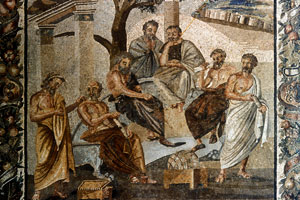
Famous Male Love and Lovers pre 1000 AD
“Love is a desire of contracting friendship arising from the beauty of the object” Cicero
‘The mightiest kings have had their minions:
Great Alexander loved Hephaestion;
The conquering Hercules for Hylas wept;
And for Patroclus stern Achilles drooped;
And not kings only, but the wisest men:
The Roman Tully loved Octavius;
Grave Socrates wild Alcibiades.’
From Christopher Marlowe’s Edward II

Sexual activity in ancient Greece, Rome and other places was generally guided by the concept of penetration of a superior over an inferior. Unlike today there was no concept of homosexuality or heterosexuality (these terms were invented in the nineteenth/twentieth century) and often no difference was seen in a man sleeping with a partner of the same or different sex. The allowances or prohibitions were guided in most part by who was active and who was passive and one’s age and status was the most important factor that described what role one could take. It was generally considered that a man would naturally be attracted to boys and women. As women had less status in most societies it was irrelevant if they enjoyed sex or not and the fact that she may enjoy being penetrated added to her perceived inferiority. It was a totally male dominated attitude and for instance, a slave or a prostitute of either sex was fair game and no constraints of morality were attached to such activity. In Greece, under certain guidelines, a free boy could be and was even encouraged to become the beloved, but in Rome a free boy could be wooed, but was forbidden to be penetrated because of his status, but the poor were available and male slaves were even bought specifically for that purpose. A boy (adolescent in modern terms) could succumb to the advances of a man from after puberty to the time he became a full adult. Where such relationships existed in Greece the boy in turn could also have a beloved as long as he was an inferior. The expected norm was that the adolescent Greek would be courted by many men and would choose one to be his lover. In early adulthood he would begin his own courting and winning the love of a deserving youth, and then he would take a wife and have children of his own. The dominant man could enjoy pleasure, but the boy who did not penetrate his lover was said to not be the one seeking pleasure and he was also to maintain dignity no matter if he became the beloved for reasons of true affection or social gain. It appears that the adult male was the only one who was permitted to claim enjoyment. The superior older male must never be penetrated and at times it was promoted even by themselves that their love was purely platonic, although Plato was alone in his disapproval. What happened in bed was private and should not be broadcast to all and sundry, but it was generally understood that sexual relations were full and were sometimes bragged about. There were cases of love and what we would call a gay relationship continuing into adulthood, but the hypocrisy of that time as well, was to deny that any male adult would allow himself to be penetrated and thus allow himself to be dominated. Homer was often vague, but hinted at the same sex encounters of Achilles. He was the most beautiful man of ancient Greece and most Greek academics of those times assumed his relationships with males to be sexual and he was described as the beloved of Patroclus although in other relationships he took on the role of the lover. Male beauty was much prised and contests of beauty were even institutionalised in the ancient world.
(summarised in part from the Oxford Classical Dictionary)
Plato was not so reticent about the sexual relationship between Achilles and Patroclus.
--------------------------------------------------------
Laius, the King of Thebes, was said to have been the first mortal to bring the practice of the love of youths to the Greeks, although some say it was King Minos of Crete. While he was still too young to rule, Laius fled Thebes to save his life, and sought refuge in Pisa. King Pelops, who was once Poseidons lover, welcomed him. When he reached manhood, Pelops entrusted his son, Chrysippus, ‘Golden Horse,’ to Laius to learn the charioteer’s art. Laius did as he was asked, but fell in love with the beautiful youth and during the Nemean games, he kidnapped the boy and took him back to Thebes where he kept him, by force, as his beloved. The young man did not live long. Some say that he killed himself in shame for having been taken against his will, but others blame Pelops’ wife who burst into Laius’s bedchamber in the middle of the night, where both were sleeping and took his sword off the wall, and plunged it into the belly of his unwilling beloved. Laius was immediately accused of the deed, but Chrysippus had recognized her and with his last breath declared the king innocent. Nonetheless Laius was thrown in a dungeon for taking the boy without his consent, an offence which became known in all of Greece as “the crime of Laius.” Pelops gathered his army and marched against Thebes to recover his son but he found the king already imprisoned and his son dead. The father, though deeply aggrieved for having arrived too late, spared Laius’ life, recognizing that it was overwhelming desire that had driven him to abduct the boy. Nevertheless he put a curse on Laius. The god Apollo, protector of youths and boys, warned him well what would happen: “No son are you to have,” said Apollo’s oracle at Delphi to Laius when he came to inquire why his wife had borne him no children, “for if you do, that boy will kill his own father and sleep with his own mother.” But Laius, always driven by passion more than by reason, of course disobeyed, and payed the price with his life. And his son, Oedipus by name, paid more dearly still.
Cicero &Titus Atticus:
Marcus Tullius CiceroThe great Roman orator 106 BC -43 BC and Titus Pomponius Atticus, a wealthy book-seller from a notable Roman Family. He grew up in Athens and took name Atticus. Cicero's treatise on friendship, De Amicitia was dedicated to him.
Darius & Zopires:
King of Persia Darius II and his eunuch Zopires.
Aristogeiton & Harmodius:
Two devoted Athenian lovers. The young and beautiful Harmodius’ sister was insulted by the tyrant Hippias’ brother and co-ruler Hipparchus. Possibly provoked by Hipparchus sexual approaches to the youth. The lovers decided to kill him at the festival of Panathenaea in 514 B.C. They succeeded but both died and were honoured as martyrs. They have been credited with the overthrow of tyranny in Athens. However it was pride and jealousy not democracy which motivated them.
Castor & Pollux (Polydeuces):
The Spartan wrestler and boxer, sons of Leda; Castor to a mortal father and Polydeuces to Zeus . They were members of the Argonauts. Both were killed in battle but because of the love for one another Polydeuces refused heaven without his beloved brother, so Zeus allowed them to alternate each day, one in heaven and one beneath the earth.
Gilgamesh & Enkidu:
Gilgamesh the Babylonian king (around 2,000-2,700 years BC) and Enkidu appear in the worlds oldest epic poem which relates the deeds of this devoted couple. Gilgamesh is so distraught at the death of Enkidu that he journeys to the underworld in an attempt to retrieve his beloved.
Damon and Phintias: (also called Pithias)
Pythagoreans and devoted friends. Phintias was condemned to death under the tyrant Dionysius and allowed to put his affairs in order. Damon offered himself as victim in place of his friend if Phintias did not return. When he did return Dionysius was impressed by their devotion, pardoned him and asked to be included in their brotherhood.
Epaminondas and Pelopidas:
Pelopidas, was born into a rich family of Thebes. He could never persuade Epaminondas to accept his charity, so Pelopidas stepped down to join him in his simple way of life. Pelopidas was interested in athletics, while Epaminondas preferred learning. They remained friends throughout their lives. Their affection started at a battle near Mantinea [384 B.C.], where Pelopidas was wounded seven times and fainted on a heap of dead men. Epaminondas stepped up to save him and his amor from the enemy, and alone, Epaminondas held off a crowd until help arrived to save them both. Pelopidas became the commander of the Sacred Band, and Epaminondas was the commander-in-chief of the army.
Julius Caesar & Nicomedes:
When he was around 20 Julius was sent to Bithynia which was conquered by Alexander the Great, became an independent country and was given to Rome in 74 BCE. Bithynia was also the land where Antinous (lover of Emperor Hadrian) was born. Julius became the young lover of the King of Bithynia, Nicomedes IV - 94 BCE to 74 BCE. Later Julius also had a relationship with his young ambitious nephew Octavius later to become Emperor Augustus.
Euryalus & Nisus:
“These had one heart between them” Euryalus and “his heart’s love” Nisus, appear only in Virgil’s Aeneid, firstly as friends in a footrace, leaders amongst all the contestants: “Euryalus famed for beauty and fresh youth, Nisus for the fair love he bore the boy. “Euryalus was modelled on Virgil’s own Alexis: “no comelier youth / Clave to Aeneus, or donned Trojan arms - Whose smooth boy-face showed faint the budding man.” Nisus was a warrior, and both died in battle. Nisus threw himself upon the body of his lover.
Hercules & Hylas:
Hercules and his squire Hylas were members of the band of bold youths, the Argonauts, who with Jason went in search of the Golden Fleece. He had kidnapped the boy after killing his father and had loved him. At Mysia the beautiful youth went in search of water and the nymphs lured him into the pool, and he was never seen again. Hercules searched the woods for his lost love, crying his name and in some versions he left the Argo at this point.
Hercules & Iolaus:
Ioläus was the sixteen year old nephew and charioteer of Hercules, and his faithful companion. As the comrade of Hercules he was worshipped beside him in Thebes, where the gymnasium was named after him.
“ And as to the loves of Hercules, it is difficult to record them because of their number; but those who think that Ioläus was one of them do to this day worship and honour him, and make their loved ones swear fidelity at his tomb”.…Plutarch.
Cleomachus & his lover

“ And you know of course how it was that Cleomachus, the Pharsalian, fell in battle.... When the war between the Eretrians and Chalcidians was at its height, Cleomachus had come to aid the latter with a Thessalian force; and the Chalcidian infantry seemed strong enough, but they had great difficulty in repelling the enemy’s cavalry. So they begged that high-souled hero, Cleomachus, to charge the Eretrian cavalry first. And he asked the youth he loved, who was by, if he would be a spectator of the fight, and he saying he would, and affectionately kissing him and putting his helmet on his head, Cleomachus, wlth a proud joy, put himself at the head of the bravest of the Thessalians, and charged the enemy’s cavalry with such impetuosity that he threw them into disorder and routed them; and the Eretrian infantry also fleeing in consequence, the Chalcidians won a splendid victory. However, Cleomachus got killed, and they show his tomb in the market place at Chalcis, over which a huge pillar stands to this day.” Plutarch
Chariton and Melanippus

“ But Hieronymus the peripatetic says that the loves of youths used to be much encouraged, for this reason, that the vigor of the young and their close agreement in comradeship have led to the overthrow of many a tyranny. For in the presence of his favorite a lover would rather endure anything than earn the name of coward; a thing which was proved in practice by the Sacred Band, established at Thebes under Epaminondas; as well as by the death of the Pisistratid, which was brought about by Harmodius and Aristogeiton.” And at Agrigentum in Sicily the same was shown by the mutual love of Chariton and Melanippus-of whom Melanippus was the younger beloved, as Heraclides of Pontus tells in his Treatise on Love. For these two having been accused of plotting against Phalaris, and being put to torture in order to force them to betray their accomplices, not only did not tell, but even compelled Phalaris to such pity of their tortures that he released them with many words of praise. Whereupon Apollo, pleased at his conduct, granted to Phalaris a respite from death; and declared the same to the men who inquired of the Pythian priestess how they might best attack him. He also gave an oracular saying concerning Chariton. ‘ Blessed indeed was Chariton and Melanippus, Pioneers of Godhead, and of mortals the one most beloved.’ Deipnosophists of Athenaus
Orestes and Pylades:
Orestes and Pylades were bywords for faithful and life-long love in Greek culture. Their story is the purest of friendships with no existing evidence of how they relate to one another as separate persons rather than Pylades, the younger of the two, being Orestes alter ego or brother. They were friends since childhood, and did much together, such as killing Clytemnestra, mother of Orestes and Elektra. “ Phocis preserves from early times the memory of the union between Orestes and Pylades, who taking a god as witness of the passion between them, sailed through life together as though in one boat........ Lucian
Pausanias and Agathon:
Agathon was an Athenian dramatist (c. 450-400 BCE). He was famous as an effeminate homosexual. It was in his house that the Dinner Party of Plato’s Symposium took place. He was around 30 and Pausanias around 40 and were still lovers at the time of the Symposium.
Epaminondas and his comrades:
Epaminondas, the great Theban general and statesman, loved his young comrades Asopichus and Cephisodorus
Parmenides & Zeno:
Parmenides, the philosopher, whose life was held peculiarly holy, loved his pupil Zeno. “ Parmenides and Zeno came to Athens, he said, at the great Panathenaean festival; the former was, at the time of his visit, about 65 years old, very white with age, but well-favored. Zeno was nearly 40 years of age, of a noble figure and fair aspect; and in the days of his youth he was reported to have been beloved of Parmenides.”
Pheidias & Pantarkes:
Pheidias, the great sculptor, loved Pantarkes, a youth of Elis and winner of the boy's wrestling match and carved his portrait at the foot of the Olympian Zeus
Corydon & Alexis:
“ Corydon, keeper of cattle, once loved the fair lad Alexis;
But he, the delight of his master, permitted no hope to the shepherd.
Corydon, lovesick swain, went into the forest of beeches,
And there to the mountains and woods-the one relief of his passion
With useless effort outpoured the following art less complainings:
Alexis, barbarous youth, say, do not my mournful lays move thee ?
Showing me no compassion, thou’lt surely compel me to perish.
Even the cattle now seek after places both cool and shady;
Even the lizards green conceal themselves in the thorn-bush.
Thestylis, taking sweet herbs, such as garlic and thyme, for the reapers
Faint with the scorching noon, doth mash them and bray in a mortar.
Alone in the heat of the day am I left with the screaming cicalas,
While patients in tracking thy path, I ever pur sue thee, Beloved.” Virgil
Philolaus & Diocles:
Philolaus was a lawgiver at Thebes and his lover Diocles was an Olympic Athlete. Aristotle relates the story of how they were buried together, and says that the inhabitants point out the tomb. Contrary to many opinions, male homosexual relationships in Ancient Greece were not just a older Athenian aristocrats having crushes on boys in the gymnasia, but included lifelong partnerships.
Polemon & Krates:
They were followers of Plato about 300 B. C “ Krates and Polemon loved each other so well that they not only were occupied in life with the same work, but they almost drew breath simultaneously; and in death they shared the same grave. On account of which, Archesilaus, who visited them in company with Theophrastus (a pupil of Aristotle), spoke of them as gods, or survivors from the Golden Age.”
Socrates & Alcibiades:
“I am far more certain about it than you or anyone else can be that Alcibiades always got up from Socrates’ bed like a child leaving the bed of its parents. And indeed it was a strange place and time - in bed and by night - to contemplate that pure beauty which Socrates is said to have loved without any improper desire, especially since he loved the soul’s beauty rather than the body’s, though in boys and not in grown men, who happen to be wiser.” Castiglione’s Book of the Courier
Socrates & Phaedo:
Socrates first met Phaedo in a house of ill-fame, according to Diogenes Laertius. Phaedo when a youth was taken prisoner in war, and sold to a slave dealer who earned money from him. A friend of Socrates bought him from his master, and he became one of the chief members of the Socratic circle. Socrates on the eve of his death stroked the beautiful long hair of Phaedo, and prophesied that he would soon have to cut it short in mourning for his teacher.”
Theseus & Pirithous:
Hercules attempted to free them from the rock to which they had been bound together in the underworld, but succeeded in freeing only Theseus, and left behind his buttocks attached to the rocks. Theseus was referred to as hypolispos, meaning “with hinder parts rubbed smooth.” Theseus and Pirithous, swore oaths on their friendship, entering into a formal bond like heterosexual marriage. One of the oldest ways of taking this oath was to place their hands upon each other’s testicles, the origin of the terms testify and testimony. Another method of swearing friendship, (blood brothers) was wrestling followed by pressing together two thumbs which have been cut with a knife.
Anacreon & Bathyllus:
Several odes of Anacreon (B.C. 5 20) are addressed to his young friend Bathyllus.
“O boy, with virgin-glancing eye,
I call thee, but thou dost not hear;
Thou know’st not how my soul doth cry
For thee, its charioteer.”
Anacreon also wrote a poem about how he on a rainy night lets in a freezing boy and allows him to get warm by the fire. The boy, however, reveals himself to be Cupid and shoots an arrow into the heart of the old man. The poem and the relief are about how old people also know love and can fall in love.
The Sacred Band of Thebes:
The Sacred Band of three hundred young lovers from Thebes. As a group cemented by friendship and love it was invincible. The lovers, ashamed to be base in sight of their beloved, would willingly rush into danger to help one another. The Theban lawgivers deliberately gave great encouragement to these friendships to soften the wildness of character of their youth. According to Aristotle lovers plighted their faith at Iolaus’s (Hercules lover) tomb thus leading to the reference to the Sacred Band.
“The beloved, when he is found in any disgraceful situation, will be pained at being detected by his lover. If there were only some way of contriving that a state or an army should be made up of lovers and their loves, they would be the very best governors of their own city, abstaining from all dishonour . . . For what lover would not choose rather to be seen by all mankind than by his beloved, either when abandoning his post or throwing away his arms. . . . Or who would desert his beloved or fail him in the hour of danger?” Plato
“ And among you Thebans, Pemptides, is it not usual for the lover to give his boylove a complete suit of armour when he is enrolled among the men ? And did not the erotic Pammenes change the disposition of the heavy-armed infantry, censuring Homer as knowing nothing about love, because he drew up the Achaeans in order of battle in tribes and clans, and did not put lover and love together, that so ‘ spear should be next to spear and helmet to helmet’, seeing that love is the only invincible general. For men in battle will leave in the lurch clansmen and friends, aye, and parents and sons, but what warrior ever broke through or charged through lover and love, seeing that when there is no necessity lovers frequently display their bravery and contempt of life.” Plutarch
The Lion of Chaironeia
They were finally beaten at the battle at Chaeronea: and when Philip, saw the band lay dead together, he wondered, and understanding that it was the band of lovers, he shed tears and said, “Perish any man who suspects that these men either did or suffered anything that was base.” The marble funerary monument which marked the communal grave of the Sacred Band of Thebans that was crushed (338 B.C.) in the battle with Philip B´ of Macedonia. It was discovered in 1818 in pieces and was restored on a plinth 3 m. high.
David & Jonathan:
“After the boy had gone, David got up from the south side of the stone and bowed down before Jonathan three times, with his face to the ground. Then they kissed each other and wept together—but David wept the most. Jonathan said to David, ‘Go in peace, for we have sworn friendship with each other in the name of the LORD.”
David’s Lament for Jonathan - Peter Abelard 1079 -1142
“Low in thy grave with thee
Happy to lie,
Since there’s no greater thing left Love to do;
And to live after thee
Is but to die,
For with but half a soul what can Life do?
So share thy victory,
Or else thy grave,
Either to rescue thee, or with thee lie:
Ending that life for thee,
That thou didst save,
So Death that sundereth might bring more nigh.
Peace, O my stricken lute!
Thy strings are sleeping.
Would that my heart could still
Its bitter weeping! “