'I think therefore I am.'  Descartes            'I AM THAT I AM.'  Exodus.3.        'I am what I am.'  La Cage aux Folles

21 December 2010

The Male in Stone

Michelangelo spoke of the form living within the marble and it was up to him to release the statue. 


In many cultures man was fashioned by the gods out of clay and the artist does the same as he brings forth his own creation. From pieces of stone, clay and molten metals images arise that have inspired mankind for thousands of years. To be able to touch and caress the textures of a statue evokes the feeling of a search for the spirit within. Perhaps we seek to see if life does exist in the image which fills our imagination with longing, questions, sometimes empathy and often awe.
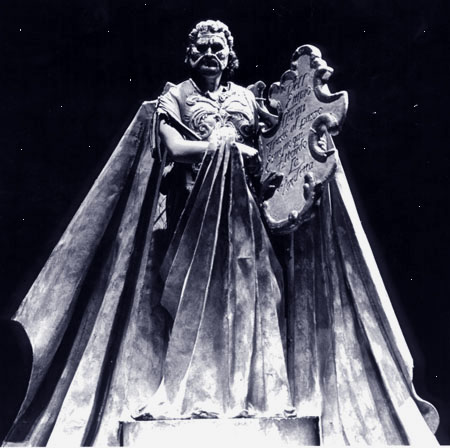


Don Giovanni  and the Stone Guest
Don Giovanni is set in Seville in the mid-17th Century. In the beginning Don Giovanni attempts to seduce Donna Anna. Her father, the Commendatore enters and challenges the Don to a duel and is killed. After several hours of the Don attempting to seduce others he is eventually hunted and takes refuge in a graveyard and laughingly relates his recent sins. A ghostly voice is heard warning that his mirth will soon end. A statue of the Commendatore appears and is inscribed with a vow of vengeance on his murderer. Don Giovanni brazenly invites the statue to supper. The statue accepts. At supper in his dining room Donna Elvira bursts in and begs the Don to change his ways, but he merely invites her to eat. As she leaves, she suddenly screams, and runs out. The Don orders his servant Leporello to go and see what was there. Leporello returns stammering about a man of stone knocking at the door. The Commendatore's statue appears and announces that he has come for supper. The Don offers his hospitality but the statue refuses mortal food, but invites Don Giovanni to sup with him. The Don accepts, giving the statue his hand as a promise, but finds himself trapped. The statue demands that Don Giovanni repent, but he refuses, and is dragged screaming off to Hell as a chorus of demons condemn him.
Wolfgang Amadeus Mozart

Sculpture goes back to Prehistoric times where Stone Age statuettes were made of ivory or soft stone, however some clay human and animal figures have been found from as far back as 30,000 - 25,000 BC. Many of the known examples of the earliest statues were of the plump mother goddess, respected for fertility by our earliest ancestors. In Sumeria, Akkadia and Babylonia much use was made of basalt, diorite, sandstone and alabaster. Copper, gold, silver, shells and precious stones were used for sculpture and inlays. Clay was used for pottery and terra cotta sculpture. Stone was rare in the near East and had to be imported. The statues were known for the large, staring eyes, and long beards on the men. One of the earliest examples of Egyptian sculpture is the make-up Palette of King Narmer, from 3100 BC. From this period on the development of sculpture progressed along strict religious lines and the examples of fine miniature work is just a precious as the colossal statues of Ramsis as seen at Abu Simbel and elsewhere. To decorate the statues gold was imported from Nubia, precious stones and pigments came from as far away as Afganitan.


All free-standing sculpture in the Golden Age of Greece was public art and many sculptors became international celebrities. The most renowned was Pheidias who created the gigantic forty foot high gold and ivory statue of Athena in full armour for the interior of the Parthenon, and one of the seven Ancient Wonder’s, the gold statue of Zeus in the sanctuary at Olympia. Both these enormous wonders have been lost to history but he is also said to have worked on the frieze on the Parthenon which does remain as the controversial Elgin Marbles in Britain.

Perhaps one of the greatest expressions of love was the creation of over two thousand statues of a beautiful boy Antinous within a few years of his death. Statues for veneration were spread throughout the entire Roman World. He was loved by the Emperor Hadrian and at the age of eighteen he mysteriously died while travelling on the Nile. Such was Hadrians devotion that it led to led to his immediate deification. He was to be the last of the Roman Gods. There is much more on Antinous elsewhere on this site.

Sculpture in Flesh - The Human Statue

15 December 2010

Music - The Madness of the Muses


The ancients played instruments, sang hymns and rustic tunes, danced for the gods and for pleasure. Apollo gave music to mankind and David sang his psalms. Everyone from Richard the Lionheart to a friend has a go at a tune. Why do we make music and sing? It seems that speech can convey much of what we wish to communicate, but when we sing we seem to move to a level that also transmits the soul of what we feel. Music takes many forms which we like to categorise as ethnic, classical, techno etc. etc. but while all might not speak to us individually, music of one sort or another does form part of the life of most human beings and has always done so. It has been said that music is as old as civilisation, as old as man, or even older. Birds are known to create their own song and they pre-dated us by millions of years. From cave paintings dating back some 40,000 years we see our ancestors dancing. Perhaps it began with percussion, a reed blown or whatever, but soon we find stringed instruments and there are many examples excavated or represented in ancient temples and on discovered artefacts.

One of the overpowering images I have of a great lost love, which appeared to suit him, is that of a single musical note. Not the sound, because that would be a complete Mahler Symphony, but the appearance of one solitary, little crotchet. He danced, he sang, and his body had a flow of graceful proportions that moved and pounced like a piece of music that stirs the imagination and passions. To look at him was like looking at a note on a page that is waiting to be brought forth, producing glorious sounds or feelings that will make the world want to dance or sing. When he created music of his own it had an originality that spoke immediately to me. When he sang, his voice  came from a strange and lonely place deep within his soul. There was pain, there was anguish there was a soul in the notes he screamed at you. Dance to him was such a personal activity. He danced for himself and there was no inhibition as his body used to leap and throw the passions within him out into the world and at himself. For him, just to stand was an expression of beauty. A fine, delicate piece for solo instrument, incomplete and tantalising. In contrast to the way he expressed himself in dance and song, he walked with an air of choreographed restraint, and spoke in a voice that was soft and lyrical, with the modulations of a Romantic string trio.

Mythological Beginnings

There were nine Muses (daughters of Jupiter and Mnemosyne). Calliope - the muse of epic poetry, Clio - the muse of history, Euterpe - the muse of lyric poetry, Melpomene - the muse of tragedy, Terpsichore - the muse of choral dance and song, Erato - the muse of love poetry, Polyhymnia - the muse of sacred poetry, Urania - the muse of astronomy and Thalia - the muse of comedy.


Mercury invented the Lyre by drilling holes in a tortoise shell and adding nine strings in honour of the nine Muses. He gave the Lyre to Apollo. The Muse Calliope bore a son, Orpheus. Some say Apollo was his father or his lover and had taught him to play the lyre which he subsequently left him as a love gift when they parted. Orpheus' playing was so beautiful it entranced both man and beast and because of his explorations and the wisdom he gathered, he set about changing his people to appreciate music, abandon bloody sacrifice and also taught the love of boys. Women were denied this knowledge, banned from the mysteries and so sought revenge on the boy lovers.  When he joined the Argonauts his strings helped launch the Argo, his music set the rowing pace and his gentle song put the guarding Dragon to sleep when they found the Golden Fleece. Returning from the voyage he married Euridice, but sadly she died, so he followed her to  Hades, the underworld, and his singing bought her release, but when, against warnings, he looked at her at the moment of escape he broke a vow and she once again returned to the shadows of the underworld. He gave up the love of women and became a priest of Apollo and his favourite love was Calais the Son of the North Wind who had wings on his head and feet. They had met on the Argo. At the time of the festival of Dionysus the Thracian women broke into the temple and murdered the men including Orpheus. Their screams had drowned out his music and thus being no longer protected, he was torn to pieces and the lyre was thrown into the river. It was said that a nightingale sings more sweetly at his grave and also that Zeus sent a vulture to retrieve the Lyre, which he placed among the stars as the constellation Lyra. Others say that it was the Nine Muses who carried the Lyre into the heavens. Lyra is next to Hercules and it is suggested that it was placed there to sooth him.

Ancient Instruments

The Didgeridoo is the sacred sound and the spirit of Australia. Today it accompanies all ceremonial, sacred and festive occasions throughout the country. This unique instrument originated in Arnhem Land, in the north of Australia, and has endured from the past and captured the soul of the modern Australian.


There is evidence from Slovenia that 50,000 years ago the Neanderthals constructed a flute from prehistoric cave bear bone. "The flute of course was broken in some ways, but sufficiently intact that you could make a guess at what kind of a flute it might have been....the dexterity as well as the intellectual insight to construct such a thing is quite considerable.." Doctor Jelle Atema- a biologist and flautist has reconstructed such items from pre-history.

An ancient Egyptian Sistrum and the earliest complete and playable musical instruments - 9000 year old bone Flutes from China. 

                                       
Music pervaded ancient Greek culture. It accompanied festivals both religious and celebratory, funerals, banquets, for the army and in the home. It was anintegral part of the education of boys. The great epics of Homer were chanted and dancing. The lyre and the flute predominated and developed into more complex instruments with the addition of extra strings or reed pipes and holes. Like today, music consisted of many modes (scales- harmoniai).  Although singing followed the melodic line the instrumentation grew in complexity, and embellishment from the written note soon developed, but earned the disapproval of the conservative Athenians including Plato.

In ancient Rome music and musicians were regarded with contempt and music was not part of the standard education of boys. Musicians formed guilds which were originally for self protection. However music must have had some importance as there was much consternation in 311BC, as Livy describes, when the flute players went on strike. The late republic saw an encouragement of music and then the Emperors Augustus and Nero did much to encourage competition. Domitian built a music hall in the centre of Rome for these contests. Music accompanied pantomimes and there were also concerts by large ensembles held in the theatres as well as the wide spread use of music at dinners and banquets. Apart from the lyre and flute, an Etruscan influence introduced trumpets and horns particularly for funeral rituals.

10 December 2010

Fundamentalism

It has appeared in the past, but a re-emergence in recent decades has been what is called fundamentalism in all the major religions. I am not sure who put such a tag on what appears to be no more than the emergence of radicalism that stems from a bias towards a literal interpretation of beliefs and ignores scientific fact, cultural perspective and love. To me ‘Love’ should be at the core of most belief. When I say literal, I mean a particular interpretation of the written word, for even then we read or translate an idea according to our own bias. Often I see it as the result of a lazy mind, which finds it simpler to berate others to justify one's own perceived superiority.  Perceived or recognised unfair distribution of wealth can cause frustration and anger on one hand and on the other, greed is often the source of a need to maintain dominance. Also blind belief can be an excuse for or a subconscious expression of a more secular political ambition. How anyone can be so sure of being right when millions can hold to truths that have other names mystifies me. Are we so sure of ourselves? Surely we all search and surely it would be better to share our understandings, find commonality and all make progress from there. All religions develop, change and grow, and to me it would be obvious that if the human condition is worth it, we should be advancing together and towards a common understanding, not strengthening hatreds born of badly informed ignorance and even more damning, a laziness of the mind. Many mistakes are made in understanding because we are human - not because we are evil.

Why is the central strength of so many religions the need to specifically define what is presumed to be wrong in others? I do hear more of what is considered to be bad than how we should be nice to one another, but then again I am subject to what the media will tell me of the statements of those in religious power. The promotion of bias and xenophobia in the media is truly rife.
Do we pray? Do we believe in angels? Do we clutch at crystals? Do we gather strength from pyramids? Do we believe in magic? Do we think that God will help us win the Lotto, and is God on our side when we go to battle? Do we think of anything, but our pleasures or our survival in the immediate? Symbols strengthen our resolve and aid us in focusing our thoughts. We have several senses and they are all bought into play when we experience life within and around us. We are perhaps body and soul and they are inseparably united to make us what we are. We need to touch, see and hear that which we try to understand. The sound of a hymn or a chant can aid in lifting the spirits, the sight of an image can remind us of a thought and all about us teaches or as some prefer, the absence of an image leaves the mind clear to contemplate the divine unhindered. I would like to have the freedom to choose what is best for me and even that may vary from time to time. To everything there is a season.  There are so many ways to contemplate the meaning of life.  None of us are the same so forced adherence to the ideas of another is not the answer. If we were all identical in thought and obedience the human condition would not grow, understanding would not change or ever progress and we may as well have no freedom to wonder or question and thus would we be human anymore? Why would we bother?

Related Posts Plugin for WordPress, Blogger...